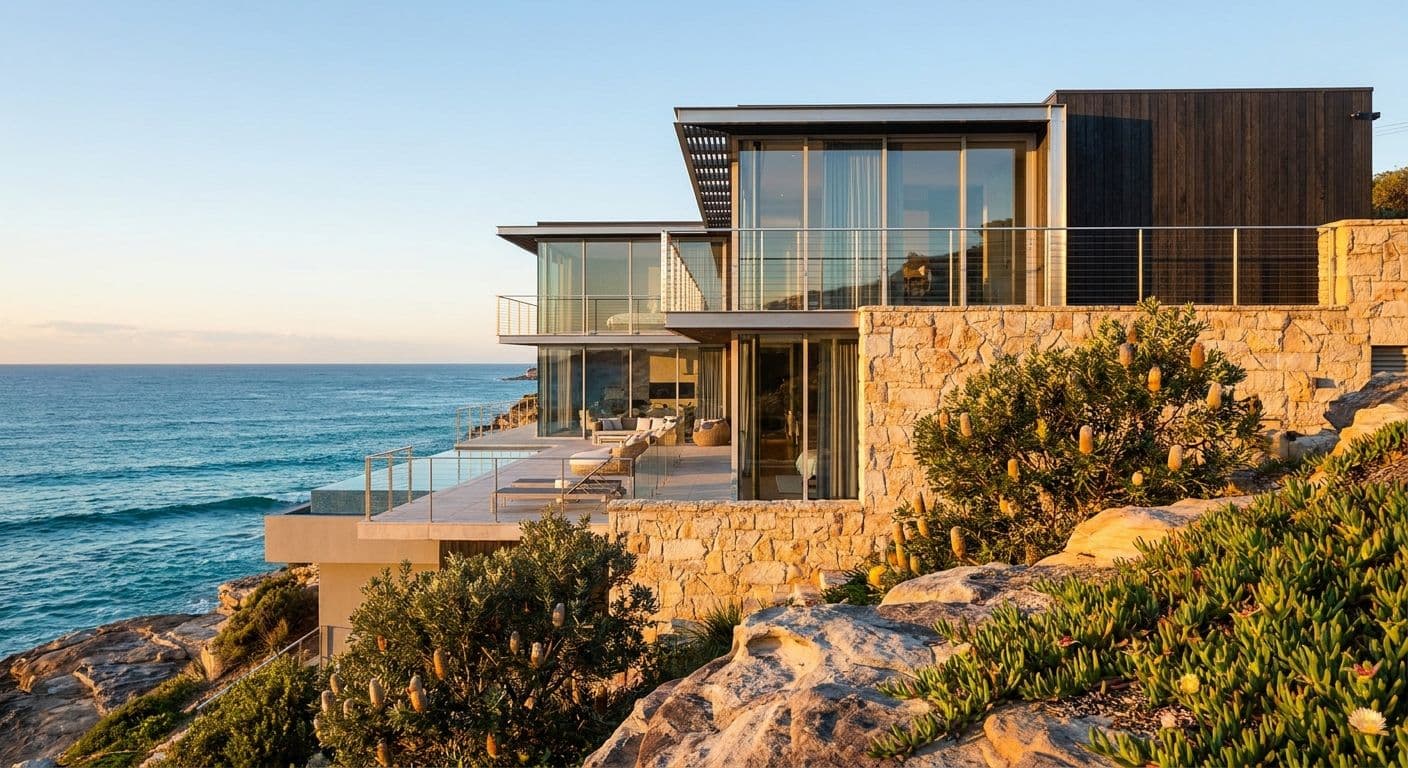
The Coastal Premium: Navigating Corrosion and Climate Risk in Shoreline Architecture

By Andre Lang · High-value home insurance specialist
Last updated 7 June 2026
The allure of the Australian shoreline is undeniable. From the rugged cliffs of the Great Ocean Road to the sun-drenched bays of the Whitsundays, coastal living represents the pinnacle of the national lifestyle. However, for the owners of premium shoreline architecture, this proximity to the ocean comes with a significant 'Coastal Premium'—a tax paid not just in property value, but in the relentless battle against one of nature's most corrosive environments. In 2026, as climate volatility increases, navigating these risks requires more than just high-end aesthetics; it demands a forensic approach to material science and structural engineering.
The Chemistry of the Coast: Understanding Aerosol Salt
To protect a coastal asset, one must first understand the enemy. Salt-laden air, or aerosol salt spray, is a pervasive force that can travel several kilometres inland depending on wind patterns. When these microscopic salt crystals land on a surface, they attract moisture from the air, creating a concentrated electrolytic solution that accelerates the oxidation of metals and the degradation of organic materials.
Under the ISO 9223 standard, much of the Australian coastline falls into the C4 (High) or C5 (Very High) corrosivity categories. In these zones, standard building materials that might last 50 years in a suburban setting can fail in less than five. This chemical reality dictates every facet of shoreline architecture, from the choice of fasteners to the orientation of the building envelope.
Material Science: The New Standards for 2026
Modern shoreline architecture has moved beyond the 'disposable' mindset. High-net-worth homeowners are now investing in materials that offer molecular-level resistance to chloride attack.
Marine-Grade Metals
The shift from 304 to 316-grade stainless steel is now a baseline requirement. However, for extreme exposures, architects are increasingly specifying 'Super Duplex' steels or titanium for critical structural fixings. Anodised aluminium, with a coating thickness of at least 25 microns, provides an excellent strength-to-weight ratio for window frames while resisting the 'pitting' that plagues cheaper powder-coated alternatives.
Timber and Polymer Composites
Australian hardwoods like Spotted Gum, Jarrah, and Ironbark remain popular for their natural resilience. In 2026, we are also seeing a rise in 'Accoya'—acetylated wood that has been chemically altered to prevent water absorption, making it virtually immune to the rot and warping typical of salt-heavy environments. For non-visible structural elements, high-density polymers are replacing traditional materials to eliminate the risk of corrosion entirely.
Structural Integrity and 'Concrete Cancer'
Perhaps the most insidious risk to shoreline architecture is concrete spalling, colloquially known as 'concrete cancer'. In coastal zones, the carbonation process is accelerated by salt. Once chlorides reach the internal steel reinforcement, the resulting rust expands the metal, causing the concrete to crack and flake away.
- Increased Concrete Cover: Specified minimum depths of 50mm-70mm over reinforcement.
- Galvanised or Stainless Rebar: Ensuring the 'skeleton' of the building cannot oxidise.
- Hydrophobic Admixtures: Chemical additives that make the concrete matrix water-repellent.
Climate Risk: Erosion and Rising Tides
The 'Coastal Premium' also involves accounting for the physical movement of the coastline. With rising sea levels and more frequent East Coast Lows bringing storm surges, the structural engineering of 2026 focuses heavily on foundation stability.
Deep-piled foundations that reach bedrock are becoming the standard for cliffside and beachfront properties, ensuring that even if surface soil is lost to erosion, the primary structure remains uncompromised. Furthermore, 'sacrificial' lower levels—designed to allow water through-flow during extreme surge events—are being integrated into high-end designs to protect the primary living zones above.
The Role of Smart Technology in Asset Protection
Technology is now a critical ally in coastal maintenance. Smart home systems in 2026 can include atmospheric sensors that monitor outdoor salinity levels. When salt concentrations reach a specific threshold after a storm, automated freshwater misting systems can be triggered to 'rinse' the building envelope, neutralising the corrosive threat before it sets in.
Additionally, automated cyclone-rated shutters serve a dual purpose: protecting glazing from wind-borne debris during storms and providing a secondary barrier against salt spray during the periods of highest vulnerability.
Insurance and Valuation: Protecting the Investment
From a market perspective, the way coastal properties are valued is shifting. Discerning buyers and insurers now look beyond the 'view' to the 'resilience'. A property built with inferior materials in a high-corrosion zone is increasingly seen as a liability rather than an asset.
Premium home insurance for shoreline architecture often requires a documented maintenance schedule. Proving that the facade has been regularly cleaned and that mechanical systems (like air conditioning condensers, which are highly prone to salt failure) are protected can lead to significantly lower premiums and higher resale confidence.
Conclusion: The Future of Shoreline Architecture
Building on the Australian coast is an exercise in controlled defiance. While the elements will always seek to reclaim the land, modern architecture and material science provide the tools to sustain luxury living in these volatile zones. By prioritising marine-grade specifications, structural foresight, and proactive maintenance, owners can ensure their coastal sanctuary remains a legacy rather than a burden.
As we move further into 2026, the definition of a 'premium' home is changing. It is no longer just about the finish on the kitchen benchtop, but the invisible defences that keep the salt at bay and the foundations firm against the rising tide.
Frequently Asked Questions
What is the difference between 304 and 316 stainless steel for coastal homes?
304 stainless steel contains chromium and nickel but lacks molybdenum, making it susceptible to 'tea staining' and pitting in marine environments. 316-grade stainless steel includes 2% molybdenum, which significantly increases its resistance to chlorides (salt), making it the minimum standard for any property within 5km of the Australian coast.
How often should coastal architectural elements be cleaned?
In 'very high' corrosion zones (within 500m of the ocean), exterior surfaces including windows, balustrades, and cladding should be washed down with fresh water every 1 to 3 months. Properties further inland may extend this to 6 months, but regular maintenance is critical to prevent salt crystal accumulation from etching into protective coatings.
What is 'Concrete Cancer' and why is it common near the ocean?
Formally known as concrete spalling, it occurs when salt air penetrates porous concrete and causes the internal steel reinforcement (rebar) to rust. As the steel corrodes, it expands, cracking the concrete from the inside out. In coastal zones, using galvanised rebar or increasing the 'concrete cover' (the thickness of concrete over the steel) is an essential preventive measure.
Related insights
Explore our cover

Andre LangHigh-value home insurance specialist
Andre Lang is a high-value home insurance specialist who advises owners of architecturally significant and high-net-worth Australian homes on protecting their property, fine art, and collections.