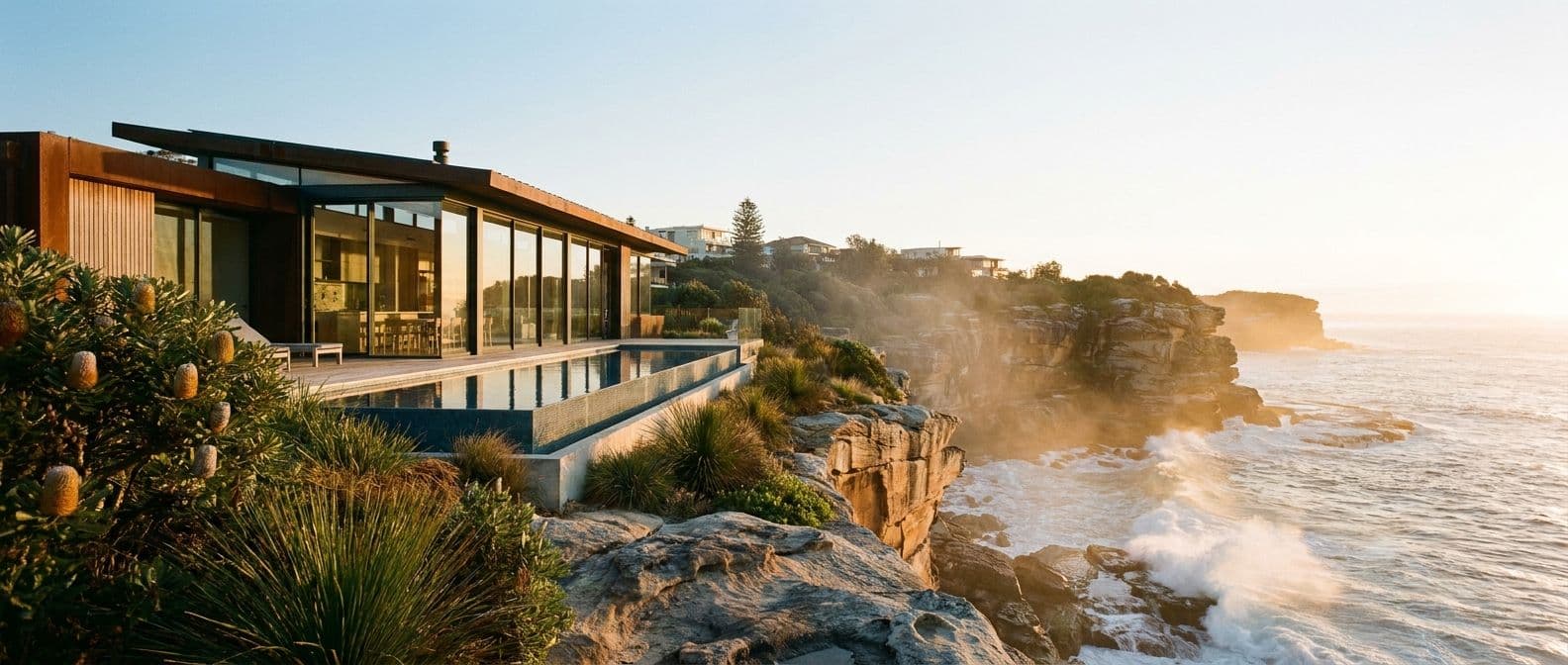
The Coastal Conflict: Protecting Architectural Masterpieces from Salt Air and Storm Surges

By Andre Lang · High-value home insurance specialist
Last updated 6 May 2026
For the Australian elite, the siren song of the coast is irresistible. From the sun-drenched cliffs of the Mornington Peninsula to the iconic swells of Byron Bay, coastal architecture represents the pinnacle of luxury living. However, this aesthetic triumph exists in a state of perpetual conflict. The very elements that define the beauty of these locations—the salt-laden breeze and the majestic power of the ocean—are the same forces relentlessly conspiring to dismantle the structures built to admire them.
In 2026, as climate volatility increases and sea levels continue their projected rise, protecting architectural masterpieces requires more than just premium materials; it demands a sophisticated, multi-layered risk management strategy. This guide explores the chemistry of coastal decay, the physics of storm surges, and the advanced engineering required to ensure your coastal legacy endures for generations.
The Chemistry of Corrosion: Understanding the Salt Air Threat
The primary antagonist in the coastal narrative is sodium chloride. In a coastal environment, salt isn't just in the water; it is a pervasive aerosol that can travel several kilometres inland. When these microscopic salt particles settle on architectural surfaces, they initiate a process known as electrolytic corrosion.
Galvanic Corrosion and 'Tea Staining'
Even the most expensive alloys are not immune. 'Tea staining'—the brownish discolouration of stainless steel—is a frequent grievance for homeowners. While often cosmetic initially, it signals the breakdown of the chromium oxide protective layer. Left unchecked, this leads to pitting, where small holes penetrate deep into the metal, compromising structural integrity. Galvanic corrosion occurs when two dissimilar metals meet in the presence of salt-laden moisture, effectively turning your home's joinery into a slow-motion battery that eats itself from the inside out.
Concrete Cancer: The Silent Destroyer
Perhaps more insidious is 'concrete cancer' or chloride-induced spalling. In many Australian coastal builds, salt penetrates the porous surface of concrete, eventually reaching the internal steel reinforcement (rebar). As the steel rusts, it expands up to seven times its original size, creating immense internal pressure that causes the concrete to crack and flake away. In a high-value residence, this can lead to millions of dollars in rectification costs if not addressed in the design phase.
Material Science: The 2026 Standard for Coastal Resilience
The evolution of material science has provided architects with a new arsenal of defences. When building or renovating a coastal masterpiece, the following materials have become the benchmark for durability:
- Ultra-High Performance Concrete (UHPC): Featuring low porosity and high density, UHPC acts as a near-impenetrable barrier to chloride ions.
- Grade 316 and 2205 Duplex Stainless Steel: Moving beyond standard 304 grade, these alloys offer superior resistance to pitting and stress corrosion cracking.
- Thermally Modified Timber: Ash or pine that has been heat-treated to remove organic compounds, making it less susceptible to moisture absorption and rot.
- High-Performance Coatings: Advanced PVDF (Polyvinylidene Fluoride) finishes for aluminium window frames that can withstand decades of UV and salt exposure without chalking or fading.
Storm Surges: Engineering Against the Inevitable
While salt air is a slow war of attrition, a storm surge is a blitzkrieg. As atmospheric pressure drops and winds drive the sea inland, the resulting surge can exert forces that standard residential engineering is simply not designed to handle. In Australia, we are seeing an increase in 'East Coast Lows'—intense low-pressure systems that bring catastrophic swells.
Managing Hydrostatic and Hydrodynamic Loads
Architecture in 2026 must account for two types of water force. Hydrostatic pressure is the weight of standing water against a wall, while hydrodynamic force is the energy of moving water. Protecting a masterpiece involves:
- Sacrificial Ground Floors: Designing the lower level with 'breakaway walls' that allow water to flow through without compromising the structural columns supporting the levels above.
- Elevated Critical Infrastructure: Placing electrical switchboards, HVAC systems, and home automation hubs well above the 1-in-100-year flood level plus a 'freeboard' safety margin.
- Deep Piling: Sinking foundations into stable bedrock rather than compacted sand to ensure that even if the surrounding terrain is eroded by a surge, the house remains standing.
Architectural Design as a Defence Strategy
Great coastal architecture isn't just about resisting the environment; it’s about working with it. Aerodynamic roof shapes can reduce the 'uplift' forces during high-wind events, preventing the roof from being stripped away. Deep eaves and overhangs can shield sensitive joinery from direct salt-spray contact.
Furthermore, the orientation of the building should consider prevailing salt-bearing winds. By placing service areas or solid stone 'buffer' walls on the windward side, architects can create a protected micro-climate for the more vulnerable glass-heavy living areas on the leeward side.
Maintenance as an Asset Protection Discipline
Ownership of a coastal masterpiece carries a mandatory maintenance burden. In the luxury sector, this is no longer a 'when needed' task but a disciplined protocol. High-end property managers in 2026 now utilise automated freshwater rinsing systems that spray the building envelope after high-wind events to desalt the surfaces.
A standard maintenance schedule for a multi-million dollar coastal asset should include:
- Monthly freshwater wash-downs of all exterior glazing and metalwork.
- Bi-annual inspections of silicon sealants, which can be degraded by UV and salt.
- Annual 'passivation' treatments for stainless steel to restore its protective oxide layer.
Risk Management and Insurance in a Changing Climate
As the physical risks to coastal properties increase, the financial risk management landscape is becoming more complex. Insurers are now using hyper-localised data—often down to the individual street address—to calculate premiums based on elevation and historical surge data. For owners of architectural masterpieces, standard home insurance is often insufficient.
Bespoke high-value asset insurance is required to cover the specific costs of specialised materials and artisan labour required to repair coastal homes. It is vital to ensure your policy specifically defines 'storm surge' and 'flood' in a way that matches your local geography. Furthermore, incorporating resilient design features can often be a lever to negotiate more favourable terms with premium underwriters who recognise the reduced risk profile of a future-proofed home.
The Future of Coastal Living
The conflict between the coastal dream and the coastal reality is not going away. However, by embracing advanced material science, intelligent architectural design, and proactive maintenance, owners can ensure their homes remain sanctuaries rather than liabilities. In 2026, the mark of a true masterpiece is not just how beautiful it looks on a calm day, but how effortlessly it stands its ground when the horizon turns grey and the tide begins to rise.
Frequently Asked Questions
What is the most effective material for coastal architectural hardware in Australia?
Grade 316 stainless steel, often referred to as 'marine grade', is the industry standard. However, for extreme exposure, molybdenum-enriched alloys or specialised PVD (Physical Vapour Deposition) coatings provide superior resistance to 'tea staining' and pitting in 2026 environments.
How often should coastal luxury properties undergo professional structural inspections?
In high-exposure zones like the Gold Coast or Sydney's Northern Beaches, a comprehensive structural and envelope audit is recommended every 12 to 18 months to identify micro-fissures in concrete or early-stage galvanic corrosion.
Do standard insurance policies cover gradual salt air damage?
Generally, no. Most standard policies exclude 'wear and tear' or gradual deterioration like corrosion. High-value asset protection requires bespoke coverage that accounts for the unique risks of coastal placement, including specific storm surge inclusions.
What is 'hydrostatic pressure' and why does it matter for beachfront homes?
Hydrostatic pressure is the force exerted by standing water against a structure's foundation or walls during a flood or surge. Without proper drainage and reinforced engineering, this pressure can cause catastrophic structural failure or basement implosion.
Related insights
Explore our cover

Andre LangHigh-value home insurance specialist
Andre Lang is a high-value home insurance specialist who advises owners of architecturally significant and high-net-worth Australian homes on protecting their property, fine art, and collections.