Stone, Timber, and Terrazzo: The True Cost of Replacing Premium Finishes

By Andre Lang · High-value home insurance specialist
Last updated 30 July 2026
For the owners of Australia’s most distinguished residences, architectural finishes are more than just functional surfaces; they are the soul of the home. In 2026, the trend toward 'quiet luxury' has solidified the dominance of natural stone, rare hardwoods, and bespoke terrazzo. However, as these materials become more integrated and complex, a critical gap has emerged between the perceived value of these finishes and the actual cost of their replacement.
When a disaster—be it a major leak, fire, or accidental impact—damages these high-end materials, owners often find that standard luxury home insurance policies are woefully inadequate. This guide explores why the 'true' cost of replacement is frequently double or triple the initial installation price and what homeowners must do to protect their investment.
Natural Stone: The Perils of Inconsistency and Rarity
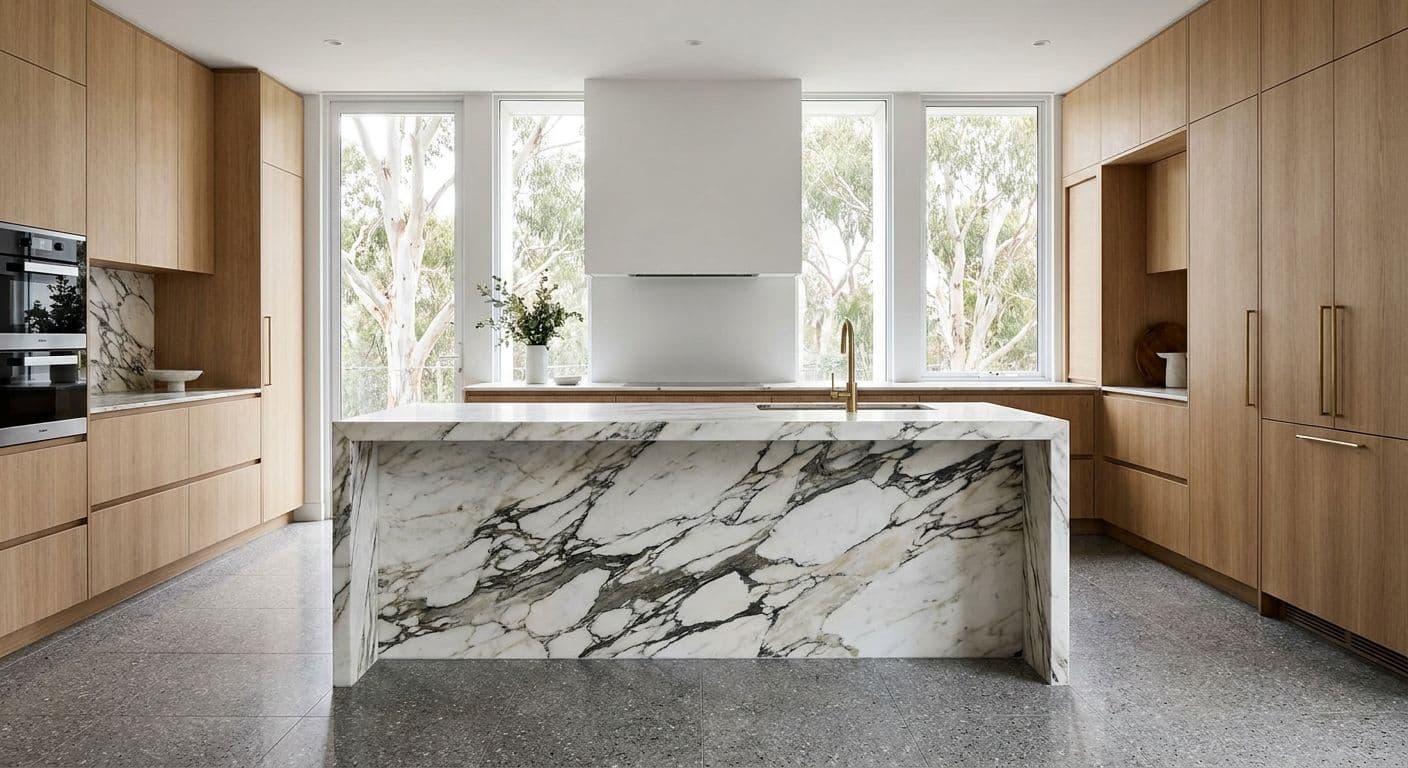
Natural stone—whether it be Calacatta marble from Italy, Brazilian Quartzite, or local Australian bluestone—is prized for its uniqueness. In high-end design, this uniqueness is precisely what makes replacement so prohibitively expensive. In 2026, the global stone market has seen a sharp rise in the cost of 'First Choice' blocks, the highest grade of stone with the most desirable veining.
The Bookmatching Nightmare
In many prestige homes, stone is 'bookmatched'—where adjacent slabs are sliced from the same block to create a mirrored pattern. If one slab in a kitchen island or a bathroom wall is damaged, you cannot simply buy another 'similar' slab. The replacement must match the colour, tone, and vein structure of the remaining pieces. Often, this requires replacing the entire installation because a matching slab from the original quarry block is no longer available.
- Sourcing Costs: International travel or specialist agents may be required to inspect new blocks in Italy or Greece.
- Fabrication Risks: Modern ultra-thin stone profiles are fragile and require CNC precision; any error during replacement fabrication restarts the expensive clock.
- Demolition of Surrounds: Stone is often integrated with custom cabinetry. Removing it without damaging the surrounding millwork is a highly specialised and time-consuming labour cost.
Bespoke Terrazzo: The Artisanal Challenge
Terrazzo has seen a monumental resurgence in Australian architecture, moving from commercial lobbies to the floors and benchtop of the nation's most expensive estates. Unlike tile, which is modular, high-end terrazzo is often 'poured in situ'. This creates a seamless, monolithic look, but it is a logistical challenge for insurers.
If a section of a poured terrazzo floor is cracked or stained, a 'patch' is almost always visible. The aggregate (the stone chips) and the binder (the cement or resin) must be exactly the same ratio, and the grinding and polishing level must match the aged patina of the rest of the floor. In 2026, the number of master terrazzo artisans in Australia remains low, meaning high-value home insurance must account for wait times and significant daily rates for these craftsmen.
Replacement Factors for Terrazzo
- Curing Times: In-situ terrazzo can take weeks to properly cure before it can be ground and polished, extending the displacement period for residents.
- Dust Management: The grinding process creates immense amounts of fine dust, requiring specialised 'hospital-grade' containment in a finished home, adding thousands to the bill.
Premium Timber: Beyond the Square Metre Rate
In 2026, the luxury market has moved away from standard engineered boards toward wide-plank European Oak, reclaimed Australian hardwoods like Blackbutt or Jarrah, and intricate parquetry. When a water leak occurs—the most common claim in luxury apartments—the timber often cups or warps beyond repair.
The true cost here isn't just the timber; it's the preparation. High-end timber floors are often glued and nailed to a perfectly levelled subfloor. Removing this requires intensive labour and often the complete replacement of the substrate. Furthermore, matching the specific stain or oil finish of an existing floor is notoriously difficult. If the damaged area is in an open-plan space, insurers may be required to sand and refinish the entire level—potentially hundreds of square metres—to ensure a uniform colour and sheen.
Why Standard Policies Fail the 'Premium' Test
The primary issue facing Australian homeowners in 2026 is 'average' costing. Most mass-market insurers use automated software to estimate rebuild costs. These tools are excellent for suburban brick-and-tile homes but fail to recognise the difference between 'marble-look' porcelain and 20mm solid Calacatta Oro marble.
The 'Like-for-Like' Clause
Standard policies often contain clauses that allow the insurer to use 'materials of a similar kind and quality'. For a luxury home, 'similar' isn't good enough. A specialist policy ensures that 'like-for-like' replacement means exactly that: the same quarry, the same timber grade, and the same artisanal application. Without this, the resale value of the home can plummet after a repair that looks 'almost' right.
The 2026 Market Context: Labour and Logistics
The Australian construction landscape in 2026 is defined by a scarcity of master trades. While a standard carpenter might be easy to find, a specialist who can lay a 5-metre single-slab marble splashback or hand-finish a chevron timber floor is rare. This scarcity drives up the 'emergency' or 'rectification' rates that insurers must pay.
Additionally, global shipping remains volatile. If your specific stone or timber is sourced from Europe, the lead times can be 6 to 12 months. A standard policy's 'Alternative Accommodation' limit may run out long before the materials even arrive on Australian shores. Specialised high-value policies account for these extended timelines, providing the financial runway needed to restore the home properly.
Risk Management: Protecting Your Finishes
While insurance is the ultimate safety net, proactive risk management can prevent the need for these complex replacements. In 2026, smart home technology has integrated with asset protection. Water leak sensors placed under stone vanities or timber flooring can alert homeowners to a burst pipe before the porous materials absorb irreparable amounts of moisture.
Regular maintenance is also key. Sealing natural stone every 12-24 months and maintaining the humidity levels for high-end timber floors can prevent the slow degradation that insurers often classify as 'wear and tear'—which is typically excluded from coverage. Documentation is your strongest defence; keeping records of the original stone blocks, the timber supplier, and the specific terrazzo mix will assist greatly during a claim.
Conclusion: The Value of Specialised Protection
The true cost of replacing premium finishes in 2026 is measured in more than just dollars; it is measured in the time, sourcing, and artisanal skill required to return a home to its original glory. For owners of Australia's most prestigious properties, a standard insurance policy is a gamble. Ensuring you have an 'Agreed Value' and a policy that understands the nuances of architectural excellence is the only way to truly protect the integrity of your home’s design.
Frequently Asked Questions
Why does stone replacement cost so much more than the original installation?
Replacement involves delicate demolition of adjacent surfaces, the potential for 'matching' issues where new stone doesn't align with existing slabs, and the high cost of specialised labour to work around finished architectural elements.
Can I just patch a damaged terrazzo floor?
While small repairs are possible, achieving a seamless match in colour, aggregate density, and polish level is notoriously difficult. Often, the entire section or room must be repoured and ground to ensure a uniform finish.
Does standard home insurance cover the full cost of premium finishes?
Most standard policies use generic 'sum insured' calculators that fail to account for the bespoke nature, artisanal labour, and international shipping costs associated with premium finishes, leading to significant underinsurance.
How has the Australian construction market in 2026 affected replacement costs?
Increased global logistics costs, a shortage of specialised master trades (stonemasons and terrazzo artisans), and high inflation in raw material prices have pushed replacement costs well above historical averages.
Related insights
Discreet Defence: Integrating Physical Security into Luxury Residential Architecture
Fire-Resistant Elegance: Marrying BAL-40 Compliance with Premium Architectural Design
The Gourmet Heart: Protecting Professional-Grade Kitchens and Culinary Assets
Explore our cover

Andre LangHigh-value home insurance specialist
Andre Lang is a high-value home insurance specialist who advises owners of architecturally significant and high-net-worth Australian homes on protecting their property, fine art, and collections.